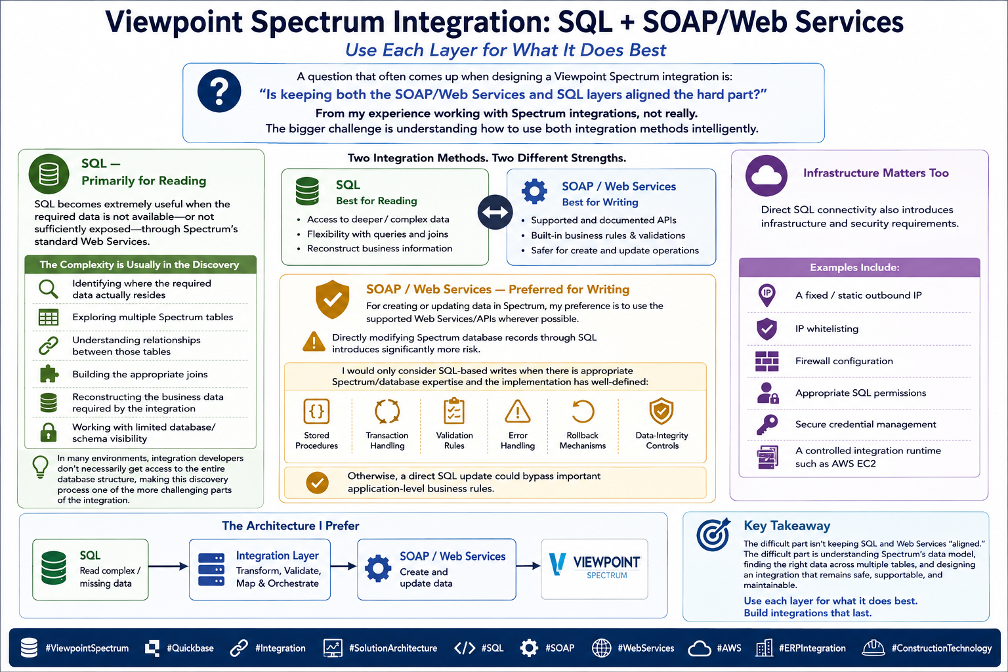
“Is keeping both the SOAP/Web Services and SQL layers aligned the hard part?”
From my experience working with Spectrum integrations, not really. The bigger challenge is understanding how to use both integration methods intelligently.
Viewpoint Spectrum integrations often need more than a single connectivity method. Spectrum’s Web Services provide a supported integration layer, while direct SQL access can become essential when complex or specialized data is not sufficiently exposed through those services. The key architectural decision is not choosing one over the other—it is assigning each layer the role it performs best.
SQL — Primarily for Reading
SQL becomes extremely useful when required information is not available—or not sufficiently exposed—through Spectrum’s standard Web Services. It provides the flexibility to retrieve deeper data, build complex joins, and reconstruct business information needed by the target platform.
The real complexity is usually in data discovery:
- Identifying where the required data actually resides across Spectrum tables.
- Exploring multiple tables and understanding the relationships between them.
- Building the appropriate joins and validating the resulting business data.
- Reconstructing information that may not exist as a single field or API response.
- Working with limited database or schema visibility in environments where developers do not receive access to the entire database structure.
This discovery effort can become one of the most time-consuming parts of a Spectrum integration. The challenge is not simply writing SQL—it is understanding Spectrum’s data model well enough to retrieve the correct business meaning from the underlying tables.
SOAP / Web Services — Preferred for Writing
For creating or updating data in Spectrum, my preference is to use the supported Web Services or APIs wherever possible. These interfaces provide a controlled path into the application and are better aligned with Spectrum’s business rules and validation behavior.
Directly modifying Spectrum database records through SQL introduces significantly more risk. SQL-based writes should only be considered when there is appropriate Spectrum/database expertise and the implementation has clearly defined controls such as:
- Stored procedures
- Transaction handling
- Validation rules
- Error handling
- Rollback mechanisms
- Data-integrity controls
Why this matters: a direct SQL update can bypass important application-level business rules, creating data-integrity and supportability risks.
Infrastructure Matters Too
Direct SQL connectivity introduces infrastructure and security requirements that need to be designed into the solution from the beginning. Depending on the client environment, these can include:
- A fixed/static outbound IP address
- IP whitelisting
- Firewall configuration
- Appropriate SQL permissions
- Secure credential management
- A controlled integration runtime such as AWS EC2
These requirements are particularly important when the integration must connect securely from a cloud-hosted environment into a client-managed Spectrum SQL Server.
The Architecture I Prefer
For complex Spectrum integrations, a practical hybrid architecture is:
| Layer | Primary Role |
| SQL | Read complex or missing data |
| SOAP / Web Services | Create and update Spectrum data |
Rather than forcing every requirement through a single integration mechanism, use each layer for what it does best. SQL provides flexibility for complex retrieval; Web Services provide a safer, supported path for transactional writes.
The Bigger Integration Lesson
The difficult part is not keeping SQL and Web Services “aligned.”
The difficult part is understanding Spectrum’s data model, finding the right data across multiple tables, and designing an integration that remains safe, supportable, and maintainable over time.
A well-designed Spectrum integration combines data discovery, application-safe write operations, secure infrastructure, and a controlled integration layer. That balance is what turns a working integration into an enterprise integration that can be operated and supported reliably.